RoamFX research 2026
What 11 money transfer services charge to send money abroad, priced from their own live quotes.
89% of what you pay is the exchange rate, not the fee
The rate difference is not shown as a fee, so most people never notice it. Wise is the one service that does it the other way round, and says so plainly: no rate markup, one fee.
$35 between the cheapest service and the most expensive
On a $1,000 transfer, into the same account on the same day.
51% is the best score any service managed
Taptap Send is the cheapest option on 51% of the routes it covers, and Wise is second on 28%. The best choice really depends on which two currencies you are sending between.
International money transfer fees are the one thing most services are open about. The exchange rate is not. Almost every service gives you a rate slightly worse than the real one, and that gap costs you more than the fee does. The real one is the mid-market rate, the number you see if you look a currency up on Google. We priced both parts on 10,254 live quotes covering 3,265 currency pairs.
Who should you use? No service wins everywhere, but a few clearly lose.
Taptap Send came out cheapest more often than anyone else, on 51% of the currency pairs it supports. It does not support as many as Western Union or Wise do, so check yours is on its list before you count on it.
Wise is the only service that shows you the whole price before you send. It converts at the real mid-market rate and charges a fee you can read on the screen. It also covers far more of them: 2,179 currency pairs against Taptap Send's 864. At 1.06% it is usually competitive without being the outright cheapest. If you want one provider you can trust that covers almost everything, this is our pick.
This page only prices one-off transfers, and Wise does more than that. You can hold a balance in most major currencies, get local bank details in a handful of them, and move money between your own currencies at the rate above. Paying someone in a currency you already hold, dollars to dollars, is usually free. Some balances earn interest. Businesses can open the same account, which is why freelancers who get paid in one currency and spend another tend to end up on it.
Xoom we would avoid. At 3.08% of the amount sent it is the most expensive service here, and it came out cheapest on just 10 of the 348 currency pairs it quotes. Only use it if the others do not support your pair. The details are below.
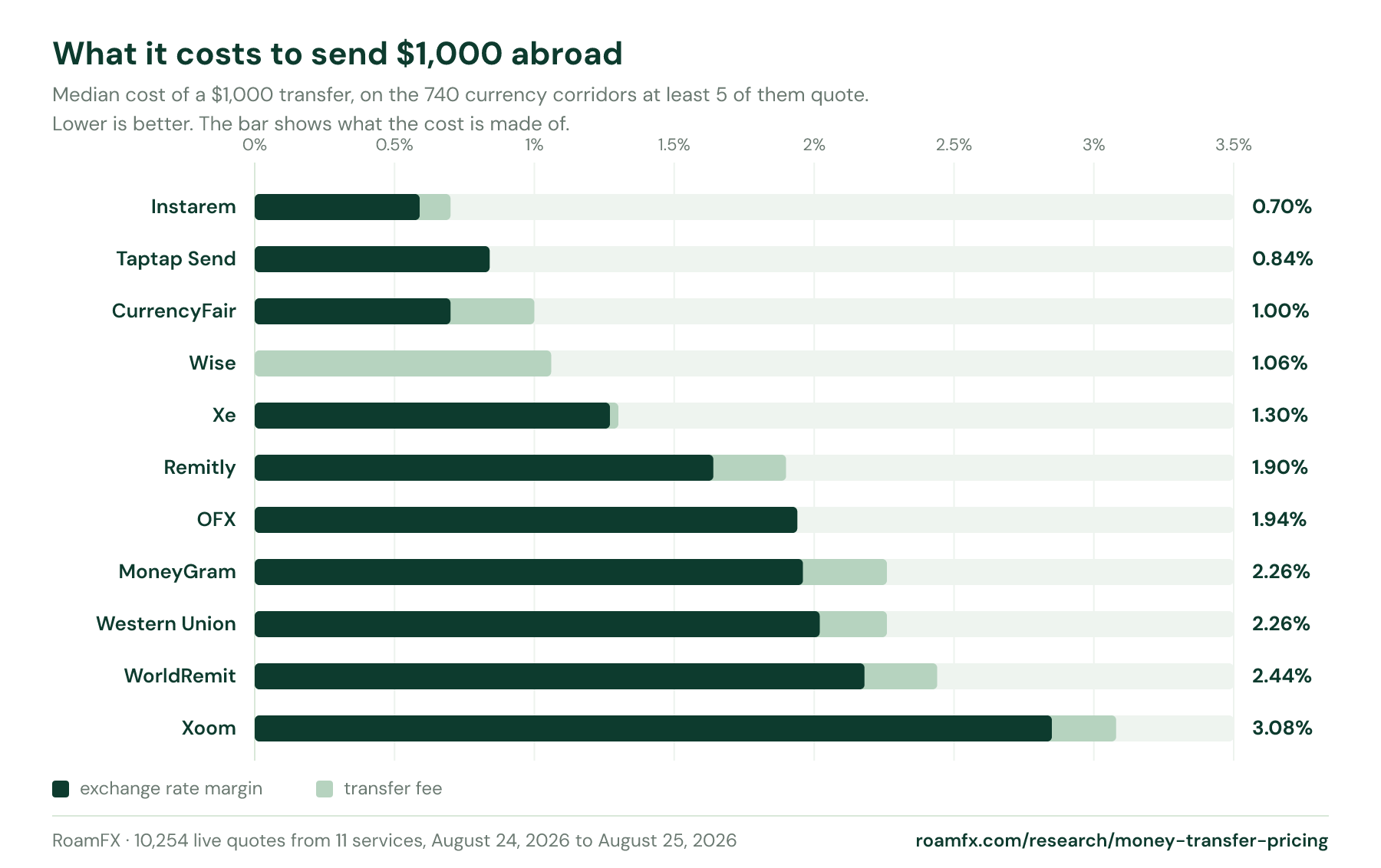
Most services make their money on the exchange rate, and it is not close: the rate costs about seven times what the fee does.
Free is not free. On the 2,986 quotes that charged no fee at all, a $1,000 transfer still lost about $15 to the exchange rate.
Each bar is one service's typical transfer, split into the part you can see and the part you cannot. The dark part is the exchange rate. Wise is the one exception and its bar shows it: it swaps at mid-market and charges an upfront fee instead, so nearly all of its cost is the pale part.
exchange rate fee
 Instarem
  Taptap Send
  CurrencyFair
  Xe
Xe  OFX
OFX  Western Union
  WorldRemit
  Xoom
Xoom Every service is measured on the same 740 corridors, the tables' word for a currency pair, so the bars can be read against each other. Bars run to 4% of the amount sent. Total cost is the rate margin plus the fee, both as a share of the amount sent, which is how the World Bank prices remittances. Fees are flat or tiered in the sender's currency, so each is priced on a transfer worth 1,000 US dollars.
On the typical corridor, $35 separates the cheapest quote from the most expensive one. The same amount on the same day, into the same account. Every service here is an online one. Banks are not in the study, and they are not usually the cheap way to send money abroad.
In the chart below you can pick one currency pair or several, and see where each service sits on them. Services whose dots sit close together charge much the same wherever you send. Services whose dots are scattered are cheap on some corridors and expensive on others, so the cheapest service last time may not be the cheapest this time.
One dot per corridor. Pick the ones you send on.
Total cost on a 1,000-dollar-equivalent transfer at the everyday rate, across 740 corridors quoted by at least 5 services. Below zero means the service paid out above the mid-market rate, which happens on a few high-volume remittance corridors and is covered under cost by region. A quote above 4% sits at the end of the track; hover it for the real number.
It changes from corridor to corridor. Across the 740 corridors that at least 5 services quote, Taptap Send was cheapest most often, on 241 of them, and beaten on the other 235. No service in the set was cheapest on more than 51% of the corridors it covers.
Winning often and covering a lot are two different things. Western Union quotes 685 of these corridors and Instarem 221. A service that covers a handful of routes can look sharp in this table and still be no use for the transfer you actually want to make.
| Provider | Cheapest on | Of corridors quoted | Win rate |
|---|---|---|---|
| Taptap Send | 241 | 476 | 51% |
| Wise | 198 | 706 | 28% |
| Xe | 103 | 673 | 15% |
| Western Union | 60 | 685 | 9% |
| Instarem | 46 | 221 | 21% |
| Remitly | 43 | 564 | 8% |
| MoneyGram | 20 | 416 | 5% |
| WorldRemit | 17 | 414 | 4% |
| Xoom | 10 | 348 | 3% |
| CurrencyFair | 2 | 297 | 1% |
| OFX | 0 | 42 | 0% |
Price is the only thing this page measures, and it is not the only thing that matters. How fast the money lands, which payout methods a service supports, what happens when a transfer goes wrong, whether it will still cover you on the corridor you need next month: none of that is in these numbers. A smaller service wins customers on price because price is the lever it has. A dollar or two saved on one transfer is worth less than a service you can keep using.
No ranking on this page uses first-transfer offers. 17% of quotes came with a better rate for your first transfer, typically worth 1.5 points, and on 41% of those the offer beat mid-market outright. But it works once, and several services cap it at the first 1,000 units of currency. Ranking on a price nobody pays twice would be no use to you. If you are about to send and want the offers counted, the calculator shows them with their terms.
Check your own corridor. Taptap Send tops this table and is still beaten on 235 of the corridors it covers.
What a transfer costs depends a lot on where it lands. Sending to Sub-Saharan Africa costs about double what sending to South Asia does, roughly $12 more on $1,000, before you have picked a service at all. We did not measure why. The usual explanation is competition: the world's busiest remittance corridors go to South and Southeast Asia, and more services compete for them.
The dark part of each bar is the exchange rate and the pale part is the fee, so the bar shows both what the transfer costs and what it is made of. The red line further right is the bad-luck case: one transfer in ten into that region costs at least that much.
| Receiving region | Quotes | Cost, and what it is made of | Median |
|---|---|---|---|
| Sub-Saharan Africa | 2,135 | 2.35% | |
| Latin America and the Caribbean | 1,586 | 2.33% | |
| Western Europe, North America, Australasia | 1,208 | 1.18% | |
| East and Southeast Asia | 1,335 | 1.18% | |
| South Asia | 644 | 1.12% |
exchange rate fee one transfer in ten costs at least this bar runs to 6%
Some currencies cost far more than any regional average. Sending to the Gambian dalasi cost 7.81%, the South Sudanese pound 7.04%, the Vanuatu vatu 6.59%. Only a handful of services quote any of them.
Both columns are total cost as a share of what you send, so lower is better: 0.08% means a $1,000 transfer arrives about 80 cents light. Read the cheap column with one warning in mind. A few of these are cheap because a service is buying the local currency below the official rate, which is a different thing from a competitive corridor.
381 quotes, 3.7% of the set, paid out more than mid-market. Nearly all of them go to five currencies, the Nigerian naira, Argentine peso, Ghanaian cedi, Botswana pula and Mozambican metical: places where a service can buy the local currency below the official rate, or where a government pays a bonus on money sent home. Those payouts are real payouts, not a rounding error in our maths.
The cost columns are all measured on the same 740 corridors, the ones at least 5 services quote, so they can be read straight down. Read the coverage column next to them. Instarem sits at the top of the table on price, but it quotes 287 corridors against Western Union's 2,564, and most of those start from a handful of rich-country currencies. A service can look cheap because it only serves cheap corridors.
| Provider | Corridors quoted | Shared | Cost, and what it is made of | Median |
|---|---|---|---|---|
| Instarem Percentage fee, waived on many corridors | 287 | 221 | 0.70% | |
| Taptap Send No fee on most corridors | 864 | 476 | 0.84% | |
| CurrencyFair Flat fee, charged in the receiving currency | 408 | 297 | 1.00% | |
| Wise1 Percentage fee plus a fixed pay-in fee | 2,179 | 706 | 1.06% | |
| Xe No fee on most corridors | 1,357 | 673 | 1.30% | |
| Remitly Fee per transfer, waived on some corridors | 993 | 564 | 1.90% | |
| OFX2 No transfer fee | 42 | 42 | 1.94% | |
| MoneyGram Fee per transfer, varies by payout method | 530 | 416 | 2.26% | |
| Western Union Fee per transfer, varies by payout method | 2,564 | 685 | 2.26% | |
| WorldRemit Fee per transfer, waived above a threshold | 600 | 414 | 2.44% | |
| Xoom No fee on bank deposit, fee on cash payout | 430 | 348 | 3.08% |
exchange rate fee captured August 24 to August 25, 2026 bar runs to 3.5%
Every quote here is a real price, taken from the service's own public calculator at the moment it was quoted and paired with the real market rate at that same moment. Where we could not get a corridor it is simply missing from the tables. We never fill a gap with an estimate.
We should say who pays for this. RoamFX earns a commission when a reader signs up with some of the services priced above. It buys nothing. The sweep runs against every service the same way, the tables are ordered by the numbers, and the only links to a provider on this page sit in the block at the very foot, below all of the evidence. A service we earn from can and does finish last on a corridor. Our full advertiser disclosure covers the rest of the site.
Questions about the method, a corridor you want checked, or a figure you think is wrong: research@roamfx.com. We would rather be corrected than quoted wrong.
Quote or republish any figure on this page in whatever you are writing, under CC BY 4.0. Just give us the credit. If you are looking for something we have not published, a single corridor or a service you think is missing, ask us and we will look into it.
Download the tables
This is our first edition. We will run the whole sweep again next year and keep this one online, so the 2026 numbers stay quotable and the two years can be compared.
If you run one of these services and think a number here is wrong, send us your own figures and we will check them against ours.
RoamFX, "International money transfer fees: 10,254 quotes, 11 services" (2026). roamfx.com/research/money-transfer-pricing
Free to use anywhere, as long as the link back stays in. The image is served from here, so it updates itself when we re-run the sweep.
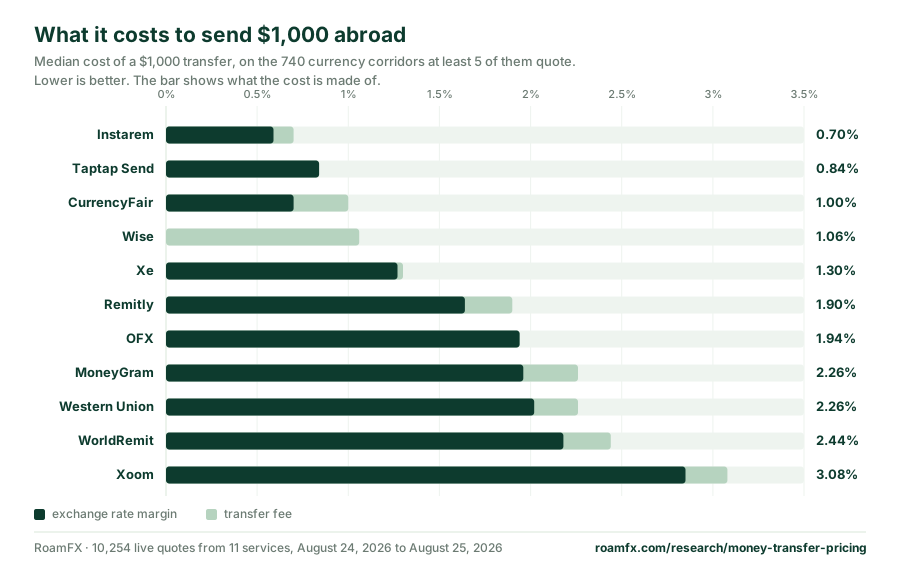
Same data, one pair at a time, priced against a live rate.
Or start with a corridor we price in full: